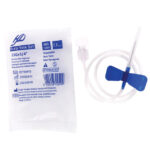
IV. CANNULA

Intravenous (IV) cannulation is a technique in which a cannula is placed inside a vein to provide venous access. Venous access allows sampling of blood, as well as administration of fluids, medications, parenteral nutrition, chemotherapy, and blood products.

Description

Intravenous (IV) cannulation is a technique in which a cannula is placed inside a vein to provide venous access. Venous access allows sampling of blood, as well as administration of fluids, medications, parenteral nutrition, chemotherapy, and blood products.

MATERIALS USED:

PTFE or FEP or PUR, Polypropylene, Polyethylene, Polyoxymethylene, Silicon, Stainless Steel, Polycarbonate, CAP and K-Resin.

INDICATIONS:

  • Infusion of fluids such as solutions, Parenteral nutrition and administration of other drugs.
  • Maintaining hydration and / or correct dehydration in patients who are unable to take sufficient volume of oral fluids
  • Transfusion of blood or blood components

CONTRAINDICATIONS:

  • Administration of highly viscous fluids
  • Large Blood transfusion
  • Not to be used in patients with known hypersensitivity to any of the materials used

DIRECTIONS FOR USE :

  1. Select proper size of l.V. Cannula. Alwavs use the smallest size cannula possible to adequatelv deliver the desired l.V. fluids.
  2. Carefully select and clean the vein puncture site
  3. Inspect Cannula package for integrity & expiry and then remove Cannula from package.
  4. Remove needle cover and grip needle hub projection.
  5. Insert Cannula into the vein at a low angle and check for blood in flashback chamber to ensure proper vein puncture.
  6. Advance the catheter into vein and simultaneously withdraw the needle with a swift, continuous motion parallel to the skin.
    It is recommended that needle hub must not be rotate (clockwise / anti clockwise), during withdrawal of needle.
  7. Dispose of needle immediately into sharp container.
  8. Avoid blood spillage by pressing a finger on the vein, on or above the catheter tip.
  9. Replace needle with either the I.V. Infusion set line or the luer lock plug.
  10. Tape down the wings of the cannula to the patient’s skin.
  11. Cover the puncture site with a sterile dressing.
  12. Drugs can be injected intermittently with the help of a syringe through the injection port after removing the port cap.
  13. The injection port cap should remain closed when not in use.
  14. Inspect vein puncture site regularly for any reactions and check all connections.
NOTE: Point No. 10,12 & 13 are applicable only for I.V. Cannula with injection port & wings.